


Resource Store
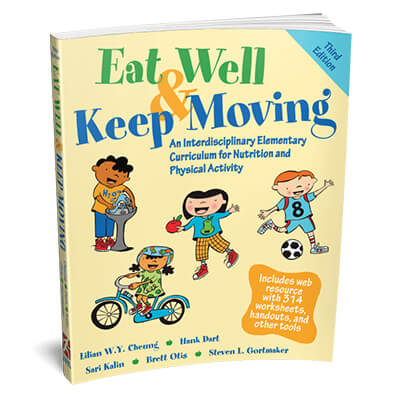
To purchase Eat Well & Keep Moving, Second Edition, visit its product page.
To purchase Planet Health, Second Edition, visit its product page.
To find detailed descriptions of other products offered by Human Kinetics, visit the Resource Store.
Contact Your Sales Rep
Contact your K-12 sales representative today for a price quote on Eat Well & Keep Moving. SPECIAL PRICING is available for bulk purchases.
How to contact us:
USA—
Phone 217-351-5076
Fax: 217-351-2674
Human Kinetics
P.O. Box 5076
Champaign, IL 61825-5076
Use the table below to contact the Human Kinetics K-12 sales representative for your state:
| Byron Clark | ext. 2423 | ByronC@hkusa.com |
|---|---|---|
| Alaska | California | New York |
| North Dakota | Montana | Puerto Rico |
| South Dakota | Wyoming | |
| Cheri Scott | ext. 2412 | CheriS@hkusa.com |
| Alabama | Arkansas | Georgia |
| Kentucky | Mississippi | North Carolina |
| Oregon | South Carolina | Tennessee |
| Texas | Utah | Washington |
| Kelly M Mullin | ext. 2386 | KellyM@hkusa.com |
| Arizona | Colorado | Idaho |
| Minnesota | New Mexico | Nevada |
| Pennsylvania | Wisconsin | West Virginia |
| Angie Holmer | ext. 2294 | AngieH@hkusa.com |
| Connecticut | Delaware | Illinois |
| Florida | Louisiana | Massachusetts |
| Maine | New Hampshire | New Jersey |
| Rhode Island | Vermont | |
| Lori Cooper | ext. 2244 | LoriC@hkusa.com |
| Nebraska | Oklahoma | |
| Cassidy Griffith | ext. 2310 | CassidyG@hkusa.com |
| Washington, D.C. | Hawaii | Iowa |
| Indiana | Kansas | Maryland |
| Michigan | Missouri | Ohio |
| Virginia | Vermont | |
CANADA
Phone: 519-971-9500
Fax: 519-971-9797
Contact Jake Rondot, e-mail JakeR@hkcanada.com.
Human Kinetics (Canada)
475 Devonshire Rd., Unit 100
Windsor, ON N8Y 2L5
FAQs
What is Eat Well & Keep Moving?
Q: What is Eat Well & Keep Moving?
A: Eat Well & Keep Moving is a school-based program that equips children with the knowledge, skills, and supportive environment they need in order to lead healthier lives by choosing nutritious diets and being physically active. The program is designed for fourth- and fifth-grade students. Its six interlinked components—classroom education, physical education, school-wide promotional campaigns, food services, staff wellness, and parent and community involvement—work together to create a supportive environment that promotes the learning of lifelong good habits.
What are key nutrition and physical activity goals for students in Eat Well & Keep Moving?
Q: What are key nutrition and physical activity goals for students in Eat Well & Keep Moving?
A: The program’s key nutrition and physical activity goals for students are summed up by six Principles of Healthy Living:
- Eat 5 or more servings of fruits and vegetables each day.
- Choose whole-grain foods and limit foods and beverages with added sugar.
- Choose healthy fat, limit saturated fat, and avoid trans fat.
- Eat a nutritious breakfast every morning.
- Be physically active every day for at least 1 hour per day.
- Limit TV and other screen time to no more than 2 hours per day.
What are the key components of Eat Well & Keep Moving?
Q: What are the key components of Eat Well & Keep Moving?
A:
- Classroom lessons. The program’s 26 interdisciplinary classroom lessons (13 for each grade) are designed so that nutrition and physical activity can be taught by classroom teachers in core subject areas, including math, language arts, and science. In addition, students learn about nutrition and physical activity while actually being physically active in the classroom. This is especially valuable in schools where physical education is limited or not available.
- Promotions for the classroom. Promotions give students and teachers fun and engaging ways to put the themes of the program into practice. These promotions include walking clubs, the Get 3-at-School and 5-A-Day promotion, the Freeze My TV contest, and the Tour de Health game.
- Physical education (physical education lessons, FitCheck, FitCheck physical education microunits, and physical education microunits). The physical education lessons offer students more traditional physical education activities, many of which also integrate nutrition topics. The FitCheck is a tool for self-assessment of activity and inactivity to help motivate students to change their behavior and reach their physical activity goals. The FitCheck physical education microunits are designed to be used with the FitCheck materials to teach students about a variety of topics in physical activity. Likewise, the additional physical education microunits are five-minute-long lessons that cover a range of physical activity topics.
- Food service. Eat Well & Keep Moving uses the cafeteria as a learning lab for nutrition. The cafeteria not only reinforces the messages learned in the classroom, but it also provides students with the opportunity to put their knowledge into practice. The Eat Well & Keep Moving CD-ROM contains detailed information for food service managers interested in making healthful changes to their school menus, including recipes, preparation tips, promotional material, classroom tie-ins, and staff training guides.
- Staff wellness. It is important for all faculty and staff involved with the Eat Well & Keep Moving program to feel empowered about their own health. If they are able to learn about and develop the skills necessary to make healthy lifestyle choices, faculty and staff will in turn be excellent role models for students. The Eat Well & Keep Moving CD-ROM contains a tool to assess staff wellness needs and interests. It also presents workshops on stress management and overall health, nutrition, and physical activity, enabling faculty and staff to not only become empowered regarding their own health but also become familiar with the topics of the classroom components.
- Parent and community involvement. The parent and community involvement component of Eat Well & Keep Moving encourages parents and guardians and family members to become involved in activities that complement the program’s messages students learn in school. The Eat Well & Keep Moving CD-ROM offers suggestions on motivating parents, creating successful parent activities, assessing community resources, and contacting community organizations to give pro bono workshops with parents. It also includes ready-to-use fact sheets and newsletter articles for promoting the Eat Well & Keep Moving messages to parents and guardians.
- School wellness policies. Eat Well & Keep Moving is a tool that will be helpful in implementing your school wellness policy. (See next question for information on school wellness policies.)
How can we use Eat Well & Keep Moving as part of the implementation of our school wellness policy?
Q: How can we use Eat Well & Keep Moving as part of the implementation of our school wellness policy?
A: Having a school wellness policy statement on nutrition and physical activity enhances the sustainability of the Eat Well & Keep Moving program. And it is now required that all local education agencies that participate in the National School Lunch Program have local school wellness policies in place.
Here is sample language that school districts can adapt to set goals for using Eat Well & Keep Moving in the classroom and for extending Eat Well & Keep Moving messages school-wide and community-wide. These goals can then be incorporated into school wellness policies:
As educators, we are committed to creating the most positive and beneficial school environment possible for students. We recognize that a comprehensive health program that emphasizes nutrition and physical activity must be an integral part of that environment. Further, we are well aware that the establishment of “healthy eating [and activity] patterns in childhood and adolescence promote optimal childhood health, growth, and intellectual development.”**
These experiences will be coordinated as part of a sequential and comprehensive educational program that includes the promotion of good nutrition habits and active lifestyles among members of the school community and of the community at large. These experiences will be addressed in
- supplementary classroom and physical activity materials;
- cafeteria promotions that target eating healthy meals in the cafeteria;
- promotional campaigns; and
- wellness, nutrition, and activity programs that are administered to parents, faculty, and staff.
We must do more than increase students’ knowledge in the areas of nutrition and activity. We are committed to providing educational experiences that
- increase awareness of and interest in health among teachers, food service personnel, and other staff members;
- empower parents, faculty, and staff as positive role models for students;
- reflect students’ need to make healthy food choices in the multiple contexts in which they eat (breakfast, lunch, dinner, snacks);
- offer students opportunities for instruction about nutrition, physical activity, and the consequences of inactivity by employing critical-thinking skills, teaching across the curriculum, using participatory activities, and using technology;
- require evidence that students have synthesized the information, thereby ensuring that they understand the implications of making healthy food choices and participating in more rigorous physical activity at school, at home, and in the community (for example, journal and essay writing, assignments that include reporting interaction and participation of parents and guardians or parent groups, reporting of activities that include observations of peers at school, in the community, and in the cafeteria at school); and
- integrate nutrition and activity curricula with parent programs conducted in the school, with school food service menu offerings, and with promotions that highlight making healthy food choices and participating in more vigorous activity.
Proceeding in this way, students’ understanding of nutrition and activity becomes more relevant to them and more readily points to the necessity of adopting healthy eating and activity patterns for themselves, their families, and others in their communities.
** Taken from text for newsletter article about Centers for Disease Control and Prevention (CDC). Guidelines for school health programs to promote lifelong healthy eating. Morbidity and Mortality Weekly Report 1996; 45(No. RR-9): [p.1].
Do I have to implement all the components of Eat Well & Keep Moving?
Q: Do I have to implement all the components of Eat Well & Keep Moving?
A: Eat Well & Keep Moving is a program you can make as broad or as focused as you would like. Choose the approach that works best for you. Focusing solely on the classroom portion of the program will provide students with an excellent set of knowledge and skills that they can apply throughout life. The program is at its strongest, though, when it includes the entire school community: other teachers (classroom and physical education), food service staff, the school food environment and policies, and parents or guardians. The power of the Eat Well & Keep Moving messages is enhanced even further when students are exposed to them in other classes, experience them in the cafeteria and school hallways, and put them into practice at home with their parents or guardians. That said, it makes sense to try something out on a small scale before committing to a big change. We encourage schools and individual teachers to try out a lesson or two, and then think about a broader, more coordinated implementation of Eat Well & Keep Moving.
Is Eat Well & Keep Moving a weight-loss program?
Q: Is Eat Well & Keep Moving a weight-loss program?
A: No! Eat Well & Keep Moving teaches children how to make room in their lives for healthy eating and regular physical activity and helps them limit screen time. Eat Well & Keep Moving was designed to promote good health and prevents excessive weight gain for all children. It is not a treatment program for children who are already overweight. You’ll find that although the teacher resources talk about preventing overweight, weight is not an explicit focus of the lessons themselves. Instead, we focus on promoting good health.
If I teach Eat Well & Keep Moving, won’t I lose valuable class time that I need to use to address our academic curriculum frameworks?
Q: If I teach Eat Well & Keep Moving, won’t I lose valuable class time that I need to use to address our academic curriculum frameworks?
A: Time spent teaching Eat Well & Keep Moving actually contributes to major subject skills and competencies. The repetition of themes in other classes is a key component of the curriculum’s approach. Eat Well & Keep Moving addresses state curriculum frameworks in language arts, math, science, and social studies. This means that your Eat Well & Keep Moving lessons fit into your existing curriculum—the curriculum isn’t something you need to teach in addition to your current lessons.
I’m not a nutrition or physical activity expert. How could I be expected to teach Eat Well & Keep Moving—and how can I learn how to teach it?
Q: I’m not a nutrition or physical activity expert. How could I be expected to teach Eat Well & Keep Moving—and how can I learn how to teach it?
A: Hundreds of fourth- and fifth-grade classroom teachers have become Eat Well & Keep Moving teachers. Obviously, it’s important to impart accurate information to your students. We provide background information sections in each lesson to supply accurate health promotion facts that teachers can rely on.
You can learn more about the curriculum through this Web site. Then, plan to get trained in using it. Training is available through a PowerPoint presentations available on this website or an accredited online course hosted by Framingham State College in Massachusetts. This link will take you to the Online Professional Development Center for Educators at Framingham State College—when the center teaches Eat Well & Keep Moving training, this is the site where it would be listed.
I’m overweight myself and I feel funny trying to be an example to kids. Can I be an effective teacher of Eat Well & Keep Moving?
Q: I’m overweight myself and I feel funny trying to be an example to kids. Can I be an effective teacher of Eat Well & Keep Moving?
A: Absolutely. Eat Well & Keep Moving is not a dieting program. It is a health promotion program. Many people struggle with diet and physical activity—and incorporating healthy behaviors is a lifetime commitment. Many teachers have found that their own weight status has been an asset in teaching the material because they can learn alongside their students, gain students’ trust with their honesty and experience, and start to make healthy changes in their own lives.
I’m watching my own weight. Could my own weight concerns affect how I teach the material in Eat Well & Keep Moving?
Q: I’m watching my own weight. Could my own weight concerns affect how I teach the material in Eat Well & Keep Moving?
A: Yes. It’s great to be aware of this possibility. Remember, Eat Well & Keep Moving is not a dieting curriculum. Teachers need to avoid using it to discuss dieting in general or to discuss their own weight-loss diets in particular. As advocates of a curriculum of healthy choices, teachers of any weight can adopt a “we’re all in this together” approach. For some, this approach has strengthened their connections with their students, making it easier to teach subject content.
What are the keys to successful implementation of Eat Well & Keep Moving?
Q: What are the keys to successful implementation?
A: The keys to successful implementation are teamwork, training, commitment, and coordination.
How was Eat Well & Keep Moving created?
Q: How was Eat Well & Keep Moving created?
A: Eat Well & Keep Moving was initially designed as a four-year joint research project between the Harvard School of Public Health and Baltimore City Public Schools. It was proven successful in extensive field tests with students and teachers: Administrators, teachers, staff, and students liked the program. Data also showed that students ate more fruits and vegetables, ate less total fat and saturated fat, watched less television, and increased their knowledge of nutrition and physical activity.
Since then, Eat Well & Keep Moving has evolved into a comprehensive program that can be introduced in other school systems throughout the country, including urban, suburban, and rural sites. The program has been disseminated in all 50 states and more than 20 countries.
What changes have been made to the second edition of Eat Well & Keep Moving?
Q: What changes have been made to the second edition of Eat Well & Keep Moving?
A: The second edition incorporates recommendations from the Dietary Guidelines for Americans 2005, emphasizing whole grains, fruits and vegetables, and healthy fat. It also includes two new lessons on consumption of sugar-sweetened beverages, a key determinant of overweight in children.
Can Eat Well & Keep Moving be taught with MyPyramid?
Q: Can Eat Well & Keep Moving be taught with MyPyramid?
A: The Eat Well & Keep Moving nutrition lessons encourage students to choose whole grains, fruits and vegetables, and healthy fat and to limit sugary foods and beverages and unhealthy fat. The lessons also focus on making healthy choices within each food group and choosing a variety of foods from all the groups. These messages are complementary to those of the MyPyramid food guidance system. In addition, the food group names in Eat Well & Keep Moving are nearly identical to those used in MyPyramid, so teachers who wish to integrate these resources should have no problem doing so.
Is there a program like Eat Well & Keep Moving for older grades? For younger grades?
Q: Is there a program like Eat Well & Keep Moving for older grades? For younger grades?
A: Planet Health, published by Human Kinetics, is a similar interdisciplinary curriculum on nutrition and physical activity for middle school students. While no such curriculum is available for younger students, many teachers report that they have successfully modified Eat Well & Keep Moving lessons for use in grades 2 and 3.